
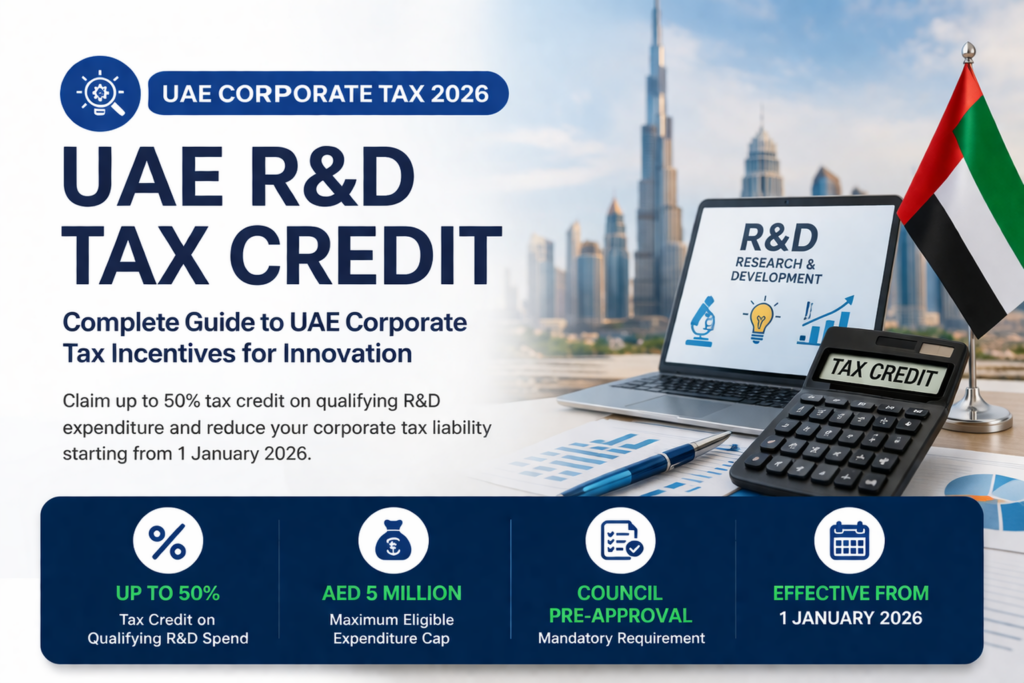
The UAE has introduced a powerful incentive to encourage innovation and business growth — the UAE Corporate Tax R&D Tax Credit Regime. This initiative allows eligible companies to reduce their corporate tax liability by claiming credits on qualifying research and development (R&D) activities.
Under Cabinet Decision No. 215 of 2025 and Ministerial Decision No. 24 of 2026, businesses operating in the UAE can receive up to 50% tax credit on qualifying R&D expenditure starting from 1 January 2026.
This guide explains everything businesses need to know about UAE R&D tax incentives, eligibility requirements, benefits, and compliance steps.
What is the UAE R&D Tax Credit?
The UAE R&D Tax Credit is a corporate tax incentive designed to encourage companies to invest in innovation, technology development, and scientific research.
Eligible businesses can claim tax credits based on expenses related to research, development, and experimentation conducted within the UAE.
Key Highlights
- Up to 50% tax credit on qualifying R&D expenditure
- Maximum eligible expenditure: AED 5 million per tax period
- Minimum project spend requirement: AED 500,000
- Applicable from 2026 onwards
- Non-refundable credit (Phase 1)
- Mandatory approval from the Emirates R&D Council
- Documentation retention requirement: 7 years
UAE Corporate Tax Structure Overview
The UAE corporate tax regime applies the following tax rates:
- 0% tax on taxable income up to AED 375,000
- 9% tax on taxable income exceeding AED 375,000
The R&D tax credit directly reduces corporate tax liability, helping companies significantly lower their tax burden.
Who is Eligible for UAE R&D Tax Credit?
A business qualifies if it:
- Is subject to UAE Corporate Tax or Top-up Tax
- Conducts qualifying R&D activities within the UAE
- Meets the OECD Frascati Manual criteria
- Bears financial risk for the R&D activity
- Owns the intellectual property or benefits from the innovation
Both mainland and free zone companies may qualify, provided they meet corporate tax requirements.
Qualifying R&D Activities
To qualify for the tax credit, R&D activities must meet the five OECD Frascati criteria:
- Innovation or novelty
- Creativity in problem-solving
- Technical uncertainty
- Systematic research process
- Transferable or reproducible results
Excluded fields include:
- Social sciences
- Humanities
- Arts research
Eligible R&D Expenses in UAE
Companies can claim tax credits on the following expenses:
- Staff Costs
- Salaries of engineers, scientists, developers
- Bonuses and benefits
- Pension contributions
- Training costs
A mandatory 30% uplift is applied to staff costs to account for overheads.
- Consumable Costs
- Materials used in R&D
- Cloud computing costs
- Software licenses
- Utilities such as electricity and fuel
- Subcontracting Costs
- Payments to UAE-based research partners
- Prototype testing expenses
- Specialist technical services
- Cost Contribution Arrangements
- Shared R&D investment between related entities
All expenses must be directly related to qualifying R&D activities conducted in the UAE.
Eligible R&D Expenses in UAE
Companies can claim tax credits on the following expenses:
- Staff Costs
- Salaries of engineers, scientists, developers
- Bonuses and benefits
- Pension contributions
- Training costs
A mandatory 30% uplift is applied to staff costs to account for overheads.
- Consumable Costs
- Materials used in R&D
- Cloud computing costs
- Software licenses
- Utilities such as electricity and fuel
- Subcontracting Costs
- Payments to UAE-based research partners
- Prototype testing expenses
- Specialist technical services
- Cost Contribution Arrangements
- Shared R&D investment between related entities
All expenses must be directly related to qualifying R&D activities conducted in the UAE.
UAE R&D Tax Credit Rates (2026)
The tax credit is applied in tiers:
R&D Expenditure | Credit Rate |
First AED 1 million | 15% |
AED 1M – AED 2M | 35% |
AED 2M – AED 5M | 50% |
Maximum credit available: AED 2 million per tax period.
Industries That Benefit Most from UAE R&D Tax Incentives
The following sectors are most likely to benefit:
- Artificial Intelligence (AI)
- Software development
- Manufacturing innovation
- Pharmaceuticals and life sciences
- Renewable energy
- Robotics and automation
- Aerospace technology
- Environmental technology
- Oil and gas technology innovation
Documentation Requirements for Claiming R&D Tax Credit
Businesses must prepare detailed documentation including:
- Pre-approval from Emirates R&D Council
- Technical project reports
- Financial statements
- Cost breakdown of R&D expenses
- Experiment documentation and methodology
- Senior management declaration
Records must be maintained for 7 years.
Compliance Checklist for Businesses
To successfully claim the UAE R&D tax credit:
- Confirm corporate tax eligibility
- Identify qualifying R&D projects
- Ensure minimum spend of AED 500,000 per project
- Obtain pre-approval from R&D Council
- Implement cost tracking systems
- Maintain technical documentation
- Submit claim within tax filing deadline
Example of R&D Tax Credit Calculation
Example:
A technology company spends AED 2,260,000 on R&D:
- 15% credit on first AED 1M
- 35% credit on next AED 1M
- 50% credit on remaining amount
Total tax credit = AED 630,000
If the company’s corporate tax liability is AED 326,250, the remaining credit can be carried forward to future tax periods.
How The Alchamii Can Help with UAE R&D Tax Credit
The Alchamii provides expert advisory services for businesses looking to benefit from UAE tax incentives.
Services include:
- R&D tax credit eligibility assessment
- Tax planning and structuring
- Documentation preparation
- Corporate tax compliance support
- Audit support and risk management
- Transfer and group tax strategy
- Ongoing regulatory updates
Conclusion
The UAE R&D Tax Credit regime offers a major opportunity for businesses to reduce corporate tax liability while investing in innovation.
Companies involved in technology, manufacturing, healthcare, and engineering should evaluate their eligibility early to maximize benefits from this incentive starting in 2026.
